Objective
State what the campaign must produce: a contact, a visit, a conversation. Not “visibility”.

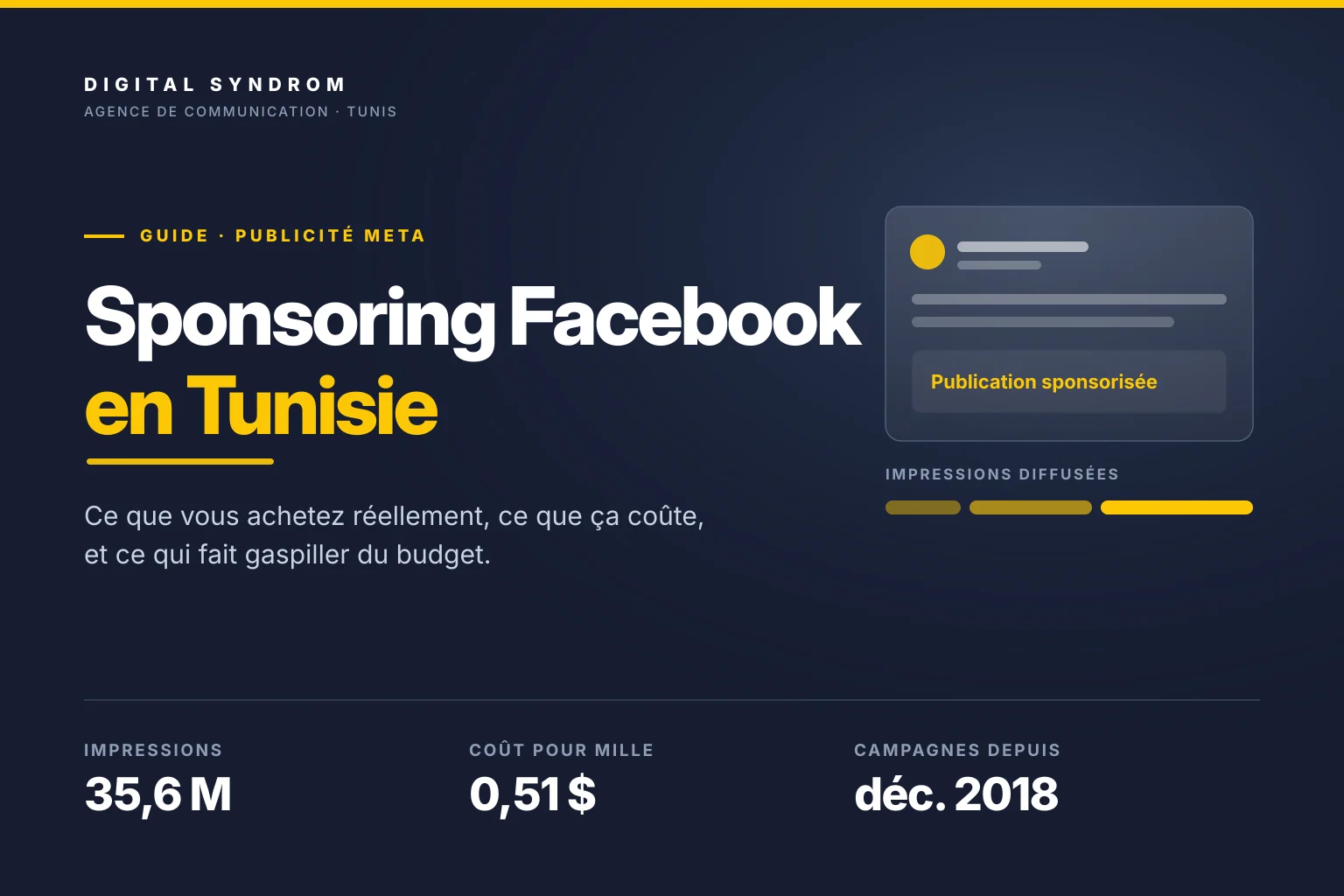
What sponsoring a post really covers, how Meta bills for delivery, and what nine years of campaigns run from Tunis have taught us about what works and what wastes budget.
In Tunisia, the word “sponsoring” means two very different things, and the confusion wastes everyone’s time. Traditional sponsorship means funding a team, a festival or a trade show in exchange for visibility on its materials. Facebook sponsoring, on the other hand, means paying Meta to show a post from your page to people who do not follow you yet.
At Digital Syndrom, “sponsoring” covers exactly two services: sponsoring posts on Facebook and Instagram, and fan acquisition on the same platforms. No patronage, no event partnerships. Making this clear avoids misunderstandings from the very first meeting.
Technically, sponsoring a post means creating an ad campaign from content that is already published. You choose an audience, a duration and a budget; Meta places your post in the feeds of the people you target and bills you for the delivery.
Meta does not sell posts, it sells impressions: the number of times your content appears on screen. So there is no price list. Every delivery goes through an auction in which your budget competes with other advertisers targeting the same audience at the same moment.
Three settings decide the outcome, and they matter more than the amount you spend:
That is why the same budget can produce very different results from one month to the next. Managing a campaign means watching that gap and correcting it.
Objective
State what the campaign must produce: a contact, a visit, a conversation. Not “visibility”.
Audience
Build targeting broad enough to last, and precise enough for every impression to count.
Content
Sponsor a post that stands on its own without budget. A boost amplifies; it does not fix.
Public benchmarks for the Tunisian market are rare. Here are ours, calculated year by year from the Meta billing receipts of our client accounts. Cost per thousand impressions (CPM) divides the amount actually paid by the volume actually delivered.
| Year | Meta budget | Impressions | CPM |
|---|---|---|---|
| 2019 | $4,469.50 | 6,775,190 | $0.66 |
| 2020 | $3,606.89 | 4,893,312 | $0.74 |
| 2021 | $3,499.23 | 5,778,975 | $0.61 |
| 2022 | $2,627.20 | 8,509,298 | $0.31 |
| 2023 | $2,959.26 | 7,292,841 | $0.41 |
| 2024 | $1,000.64 | 2,405,799 | $0.42 |
| Total | $18,162.72 | 35,655,415 | $0.51 |
Two takeaways. First, the order of magnitude is stable: around half a dollar per thousand impressions, a very low exposure cost compared with European markets. Second, the gap between years is large: CPM ranges from $0.31 in 2022 to $0.74 in 2020, more than double. The market does not move that much; targeting, format and seasonality choices do.
For budgets per post and per month, we wrote a separate article on the cost of Facebook sponsoring in Tunisia.
Sponsoring from the “Boost” button. The blue button under a post is convenient and limited. It offers a handful of objectives and basic targeting. Meta Ads Manager gives access to the same posts with real control over placements, scheduling and audiences.
Confusing engagement with contacts. A post with 50,000 impressions and 400 reactions can generate zero enquiries. If the business goal is contacts, the campaign must be set up to produce messages, calls or forms, and measured on that.
Stopping and restarting all the time. Every restart sends the campaign back into the learning phase, when costs are higher. Continuous delivery on a small budget beats a series of spikes.
Putting the whole budget on a single post. Ad fatigue sets in quickly on a national audience the size of Tunisia. Rotating three or four pieces of content over the same period keeps costs low for longer.
Not answering messages. This is the most expensive mistake, and the most common. A campaign that opens Messenger or WhatsApp conversations with nobody handling the requests the same day turns an ad budget into pure spending.
Both platforms share the same ad manager: a campaign can run on one, the other, or both. In practice, the choice depends less on the platform than on the target audience and the content format.
On our accounts, Facebook remains the main channel by budget, with Instagram carrying visual content and vertical formats. For industrial and B2B clients, Facebook still has a real professional audience in Tunisia, which is not the case everywhere. For retail, beauty or restaurant brands, Instagram naturally takes a larger share.
Fan acquisition, the second part of our sponsoring offer, follows the same logic: it is only worth it if the page then posts regularly enough for that audience to stay useful. Acquiring followers for a dormant page is spending with no follow-through.
Sponsoring reaches people who were not looking for you. That is its strength, since it creates demand, and its limit: it does not capture demand that already exists.
Someone who types “solar water heater price Tunisia” into Google is much further along in their decision than someone who comes across your post in their feed. You do not reach these two people with the same tool. That is why, for some of our clients, we run Facebook and Google Ads in parallel, and why search has taken a much larger share of our budgets since 2023.
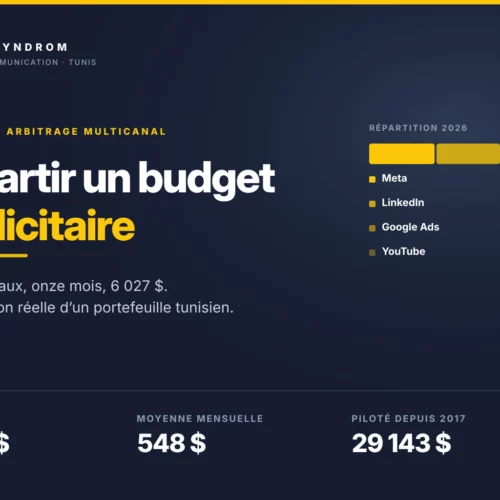
For a B2B business with a long decision cycle, LinkedIn plays a third role: more expensive per impression, but more precise on job function and industry. We have detailed the actual split of an advertising budget across these four channels. Choosing between them is not a matter of fashion: it depends on your sales cycle and on how your customers search.
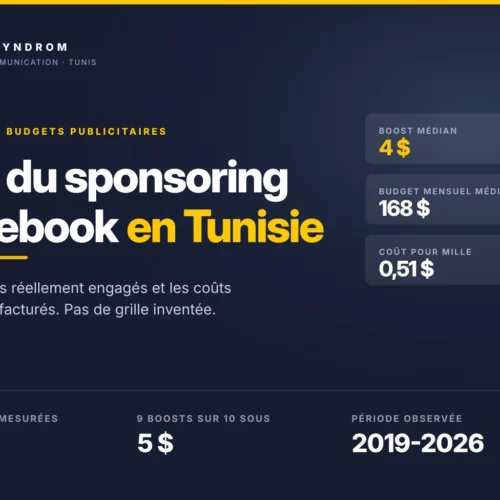
Meta allows very small budgets, in the range of a few dollars. On our accounts, the median amount spent per sponsored post is $4, and nine operations out of ten stay under $5. A sensible monthly budget for an active page starts at around $100, all content combined.
Long enough for Meta to leave its learning phase, which means several days of continuous delivery. 24-hour boosts restarted over and over cost more for weaker results.
Yes, as long as you expect the right thing from it. Facebook is still widely used by managers and technicians in Tunisia, including in industry. It helps make an offer known and open conversations. To capture demand that is already expressed, Google Ads is more direct.
Yes. Sponsoring always starts from a page post. A personal profile cannot be used to create an ad campaign.
A sponsored post starts from content already published on the page and keeps its engagement. An ad can be created directly in Ads Manager without appearing on the page. Both go through the same auction system and the same billing.
Three causes come up again and again: seasonality, which increases competition at certain times; ad fatigue, when the same audience has seen the same content too often; and targeting that has become too narrow after successive exclusions.
The amounts and volumes quoted in this article come from the billing receipts of the ad accounts managed by Digital Syndrom between December 2018 and 2026, and from internal campaign tracking. They describe our portfolio and are not a market benchmark.