Regular presence
About $50 to $80 per month. Keep the page visible and support a few posts per week.


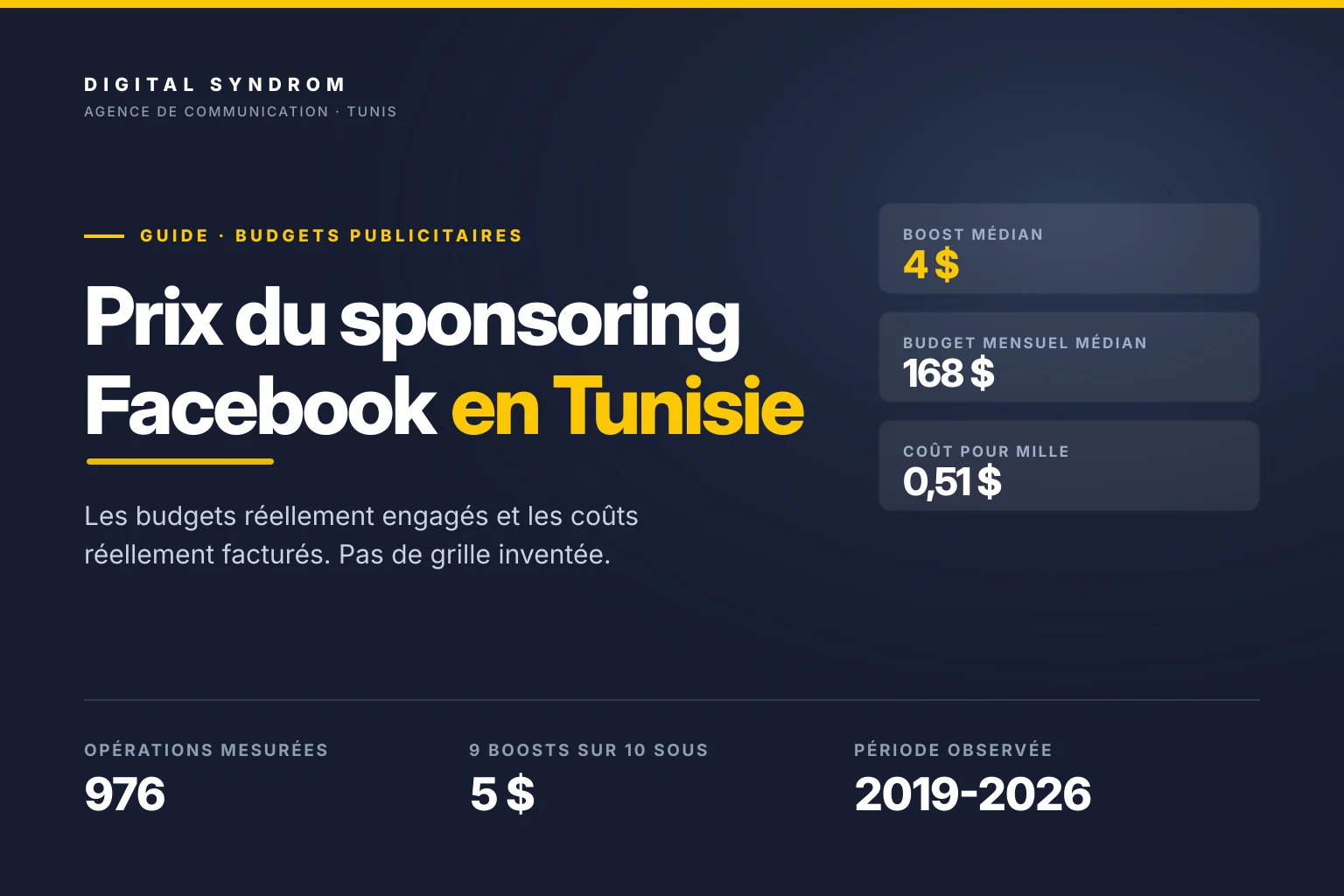
No price list, no made-up ranges. The budgets actually spent, the costs actually billed, and what makes the bill change from one month to the next.
On our accounts, sponsoring a Facebook post in Tunisia costs a median of $4 per post, and nine operations out of ten stay under $5. A sensible monthly budget for an active page is between $90 and $330, depending on the number of posts and the reach of the targeting.
Relative to the volume delivered, that is $0.51 per thousand impressions on average over seven years. But this is an average: it has ranged from $0.31 to $0.74 depending on the year.
The first thing to understand is that there is no list price. You do not pay for “a sponsored post”: you set a budget, and Meta delivers your content until that budget is used up, billing you for the impressions obtained.
The amount you commit therefore determines the duration and reach of the delivery, not its unit price. That unit price comes from a permanent auction between all the advertisers targeting the same audience at the same moment. Which leads to something many people discover late: two campaigns with the same budget can deliver very different volumes.
That is why any “Facebook sponsoring price list” published without data behind it is an approximation. The only solid figures are the ones recorded on real accounts, over time.
Across the 976 Meta boost operations recorded in our tracking sheets in 2025 and 2026, the distribution is tight:
| Benchmark | Amount spent |
|---|---|
| Most frequent boost | $2 to $4 |
| Median | $4 |
| Average | $3.79 |
| 9 operations out of 10 under | $5 |
| Highest operation | $48 |
These amounts often surprise people. They come from a logic of frequency rather than intensity: several small deliveries spread over the month, rather than a large budget on a single post. This approach keeps the page visible at all times, limits ad fatigue and makes it possible to quickly stop content that is not working.
Higher amounts, above $15 on a single post, correspond in our case to key moments: a product launch, a trade show, a dated commercial operation.
Thinking post by post makes little sense over time. What shapes an advertising presence is the monthly envelope. Across our whole Meta portfolio in 2025 and 2026, that envelope ranges from $91 to $334 per month, with a median of $168.
For a single client, the contractual budgets we manage are most often between $30 and $60 per month per network. A manufacturer advertising on Facebook, Instagram, LinkedIn and YouTube therefore ends up at around $150 to $200 a month across all channels. We have published the actual split of our portfolio across these four channels.
Three benchmarks to place a project:
Regular presence
About $50 to $80 per month. Keep the page visible and support a few posts per week.
Active acquisition
About $150 to $250 per month. Several posts in rotation, contact-oriented objectives, weekly follow-up.
Commercial peak
A budget concentrated over two to three weeks, on top of the usual envelope, for a launch or a trade show.
The budget tells you what you spend. CPM, the cost per thousand impressions, tells you what you get in return. It is the indicator that lets you compare two periods, or two campaigns with different budgets.
| Year | Meta budget | Impressions | CPM |
|---|---|---|---|
| 2019 | $4,469.50 | 6,775,190 | $0.66 |
| 2020 | $3,606.89 | 4,893,312 | $0.74 |
| 2021 | $3,499.23 | 5,778,975 | $0.61 |
| 2022 | $2,627.20 | 8,509,298 | $0.31 |
| 2023 | $2,959.26 | 7,292,841 | $0.41 |
| 2024 | $1,000.64 | 2,405,799 | $0.42 |
| Total | $18,162.72 | 35,655,415 | $0.51 |
In 2022, one dollar bought twice as many impressions as in 2020. This change does not come from a drop in market prices: it reflects broader targeting choices and better-received formats. CPM can be managed, at least in part.
A low CPM is not a goal in itself, though. Delivering very widely to people who are not concerned lowers CPM and produces nothing. The right trade-off is judged on the number of contacts obtained, not on the cost of impressions.
The time of year. Ramadan, back to school, the end of the year: Tunisian advertising competition is concentrated on a few weeks, and bids go up. The same budget then buys less delivery.
Narrow targeting. The smaller the audience, the more Meta has to pay to reach the right people. Targeting by job title, industry and area can double the cost per impression compared with broad national targeting.
The chosen objective. A campaign aimed at messages or lead forms is structurally more expensive than an awareness campaign: you are asking Meta to find people ready to act, not just to look.
Content quality. This is the most underestimated lever. A post that holds attention gets a better delivery score and costs less to show, for the same budget.
Format. Vertical video and native Reels formats are generally delivered at a lower cost per impression than a square static image.
Two expenses that many quotes mix up need to be kept apart. The media budget is paid to Meta: it is the money that buys delivery. Management fees pay for the work of design, setup, monitoring and decision-making.
At Digital Syndrom, the media budget is a monthly commitment per channel, agreed with the client. How it is split between campaigns within that envelope is part of our job: that is precisely what the client is paying for. At the end of each period, spending is documented channel by channel.
One piece of advice, whichever agency you choose: always ask for the media budget to be billed separately, and require the platform’s receipts. It is the only way to know what was really delivered.
Meta accepts budgets of a few dollars. On our accounts, the median amount per sponsored post is $4. Below $2, delivery is too short to leave the learning phase and the cost per impression climbs.
The monthly envelopes we manage range from $91 to $334 per month, with a median of $168, across all clients. For an individual client, a commitment of $30 to $60 per month per network is common.
Both platforms share the same auction system and the same billing. Costs per impression differ by audience and format, not according to a separate rate for each network.
Most often for one of three reasons: a period of heavy competition, an audience you narrowed, or content that was less well received than the previous one. The amount you spent did not change; the auction price did.
The accounts we manage are billed in US dollars. The amount charged to the card therefore depends on the exchange rate applied by the bank at the time of the charge.
For a lasting commercial presence, regularity wins. That is the choice our figures reflect: many operations of $2 to $5 spread over the month. A concentrated budget still makes sense for a launch or a specific commercial date.
The amounts quoted come from the billing receipts of the ad accounts managed by Digital Syndrom between 2019 and 2024, and from internal boost tracking sheets for 2025-2026. They describe our client portfolio in Tunisia and are not a market average.